Angels and Prophecies: Design Lessons from the Q’rath Empire
Angels and Prophecies: Design Lessons from the Q’rath EmpireIntroduction:
Hello, dear community! Dylan “ItWhoSpeaks” Kahn here. While we wait for our summer playtest, I wanted to give you some insight regarding our first faction: Q’rath, the Angelic Empire. This article is a bit of a retrospective, in which we often perform post-mortem covering what we did well and where we made mistakes, with Q’rath being a poignant reflection of what we learned in our modding days. This is an expansive topic, so I feel it’s important that we start at the beginning.
Part 1: Solving Design Challenges & The Vanguard Prototype
As some of you know, we got our start as modders in the StarCraft II community, beginning around the late “Wings of Liberty” era in the year leading up to Heart of the Swarm’s beta phase. If you played during that time, you will remember that SCII was a very different experience with very conservative strategies. This was due to the high-lethality gameplay where games could just end in the blink of an eye. Additionally, It was just safer (and optimal) to have no more than three mining bases, defending aggression until you could field a large endgame army. In general, matches at the time, as engaging as they were, didn’t feel as fun as games of Brood War despite the many advances in UI and pathing. As passionate StarCraft fans, we wanted to learn why the two games felt so different. Generally, it boiled down to SCII having a much shorter time to kill (the time it takes a unit to die in an average match up) relative to its predecessor, StarCraft: Brood War. There were a few reasons for this:
- SCII pathing was very good, allowing units to bunch up into tight “balls,” allowing more ranged fire-power to be packed into tighter spaces.
- SCII opted for a simplified damage system where units would deal bonus damage to armored or light targets that generally made “hard-counter” relationships more pronounced.
- “Area of Effect” spells such as “Psionic Storm” and “Fungal Growth” ended up being balanced against these “death-balls” in such a way that entire armies of infantry could disappear in seconds (or less).
While our Design Leads Travis and Joakim were working on the StarBow mod, Zanya, Tom, and I were working on OneGoal and the Core, a sort of predecessor to the community Public Test Realm that Blizzard eventually employed during SCII’s “Legacy of the Void” expansion (Thanks to Frost Giant’s Tim Morten for that!). Despite us not working directly with one another at first, we quickly came together because we were all investigating the same problems SCII’s multiplayer suffered from and we were all trying to solve it from different perspectives.
Ultimately, we learned that we needed a game experience with factions that did the following:
- Had a generally longer time to kill, particularly in the early game so that low-skill players could have time to react to situations and high skill players had more opportunities to outplay their opponents. (We’ll go into this more in a future article.)
- Had fewer “busy work” abilities and had more intuitive, cohesive designs, particularly passives.
- Had a stronger focus on positional advantage and respected limitations to movement and mobility, allowing for longer, back-and-forth fights.
The faction we looked at most closely was Brood War’s Protoss, which boasted durable and expensive units that felt powerful in the hands of low-skill players but required some finesse and creativity to play at a high level (thinks like Reaver-Shuttle Micro, Carrier-Interceptor leash-range, and Dragoon hold-position kiting are all relevant examples).
In time, these lessons would coalesce into the “Vanguard Mod,” which served as the foundation for IMMORTAL’s design. Going into the project, we wanted to apply the lessons we learned from our previous modding work, and we needed a faction that personified this new direction. This would ultimately become the Q’rath Empire.
What Worked:
Hallowed Ground
During Vanguard, we developed two kinds of Protoss factions, the Khalai (High Templar), and the Nerazim (Dark Templar). To mechanically differentiate the two, we really wanted the Khalai to double down on the fantasy of being powerful and tough psionic warriors contrasting to the Dark Templar’s nimbleness and stealth. The Khalai faction traded mobility for raw strength when exposed to power fields generated by their Pylon structures. This mechanic tested extremely well, allowing for the crunchy, positional back-and-forth gameplay that Brood War was so famous for. It also added additional nuance to a faction archetype (the big tough bruiser) that sometimes felt flat relative to more agile factions like Terran or Zerg.
This mechanic became Q’rath’s Hallowed Ground and it’s remained one of our most effective mechanics.
As we built Q’rath, we learned what kind of bonuses could be given to Q’rath warriors in Hallowed Ground as well as how strong they could be. A balance had to be struck. Units needed to feel noticeably stronger when fighting on their turf but we knew from the difficulties with SCII Protoss that over-reliance on a mechanic (be it Warp Gate or the Sentry’s Forcefield), can undermine the gameplay and identity of a unit and the overall fantasy of the faction. Q’rath also had to be fun to play against. Thus, things that generated Hallowed Ground had to be designed to be target-able or temporary. The Zentari boasts a brutal ranged attack when on Hallowed Ground, but due to being paired with Magi or structures, this mechanic serves as a soft anchor, allowing the enemy to out-maneuver them. Conversely, the Saoshin and Sipari are allowed to generate Hallowed Ground far more freely because the Sipari’s speed and health bonus is balanced around that increased availability.

Angelic Wards
Q’rath’s “angelic ward” mechanic was derived from Brood War’s Protoss shields wherein a unit’s HP were protected by a constantly regenerating pool of shield HP. This is different from SCII Protoss, wherein shields only regenerated out of combat. While this distinction seems small, the gameplay incentives are pronounced. Constantly regenerating shields favor units that wade into combat and stay there while out of combat regeneration favors units that embrace a skirmishing play-style, trading enemy health for “free” shields. Given Q’rath’s vitality and our desire for positional play, we opted for the former, giving the out of combat shield mechanic to the Aru due to their preference for ranged combat and ambushes.
We attempted to spice this up by giving Q’rath the ability to cast abilities by using their ward pool. This cast-from-shield mechanic was intended to incentivize players to take riskier fights but the dynamic proved to be more niche than we anticipated. Currently, the Zephyr, Dervish, Ark Mother, and Throne take wards to power their spells. It’s a great way of balancing the power of a powerful spell in certain conditions. For example, the Throne’s Tithe-Blades is a terrifying power-amplifier, but requires you to make your army a bit more brittle. This requires the Q’rath player to balance their supply between Thrones and other army units, which limits the “critical mass death-ball” problem many capital ships run into in other RTS games.
Overall, the Angelic Wards and expenditure abilities were a net success and their shortcomings taught us that attritional mechanics don’t always lead to better gameplay. This lesson would prove critical to getting Aru right, more on that in another blog post!

What Did Not Work:
Visual Design for RTS: A Trial by Error
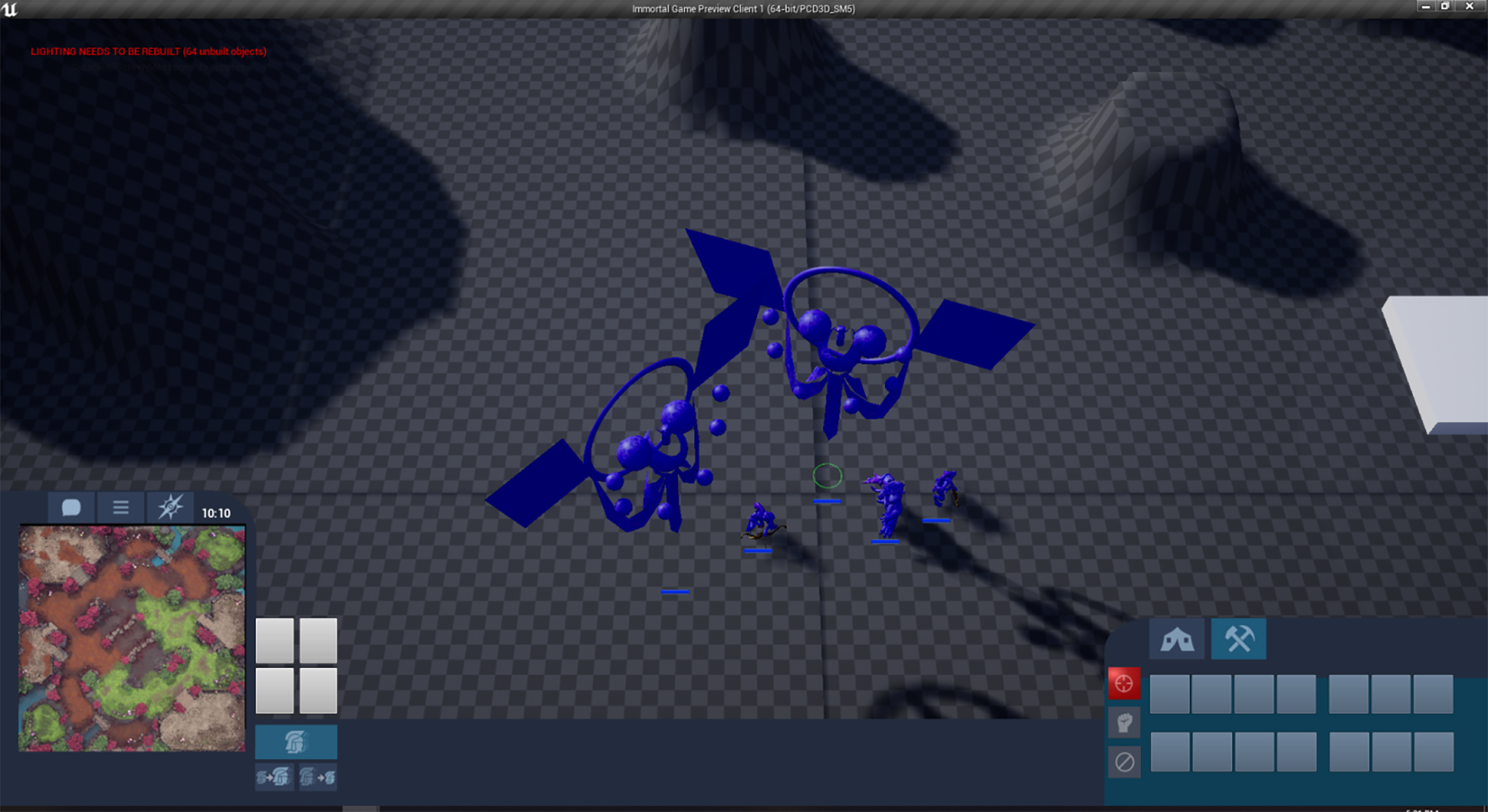
Ultimately, we knew that units had to be readable from an RTS perspective, but it was quite another thing to get it right in practice. This was especially true when accounting for larger army sizes, multiple particle effects, and environmental lighting, team color, and faction fantasy. One of our early lessons was designing the Throne. Here was our first in game art test:
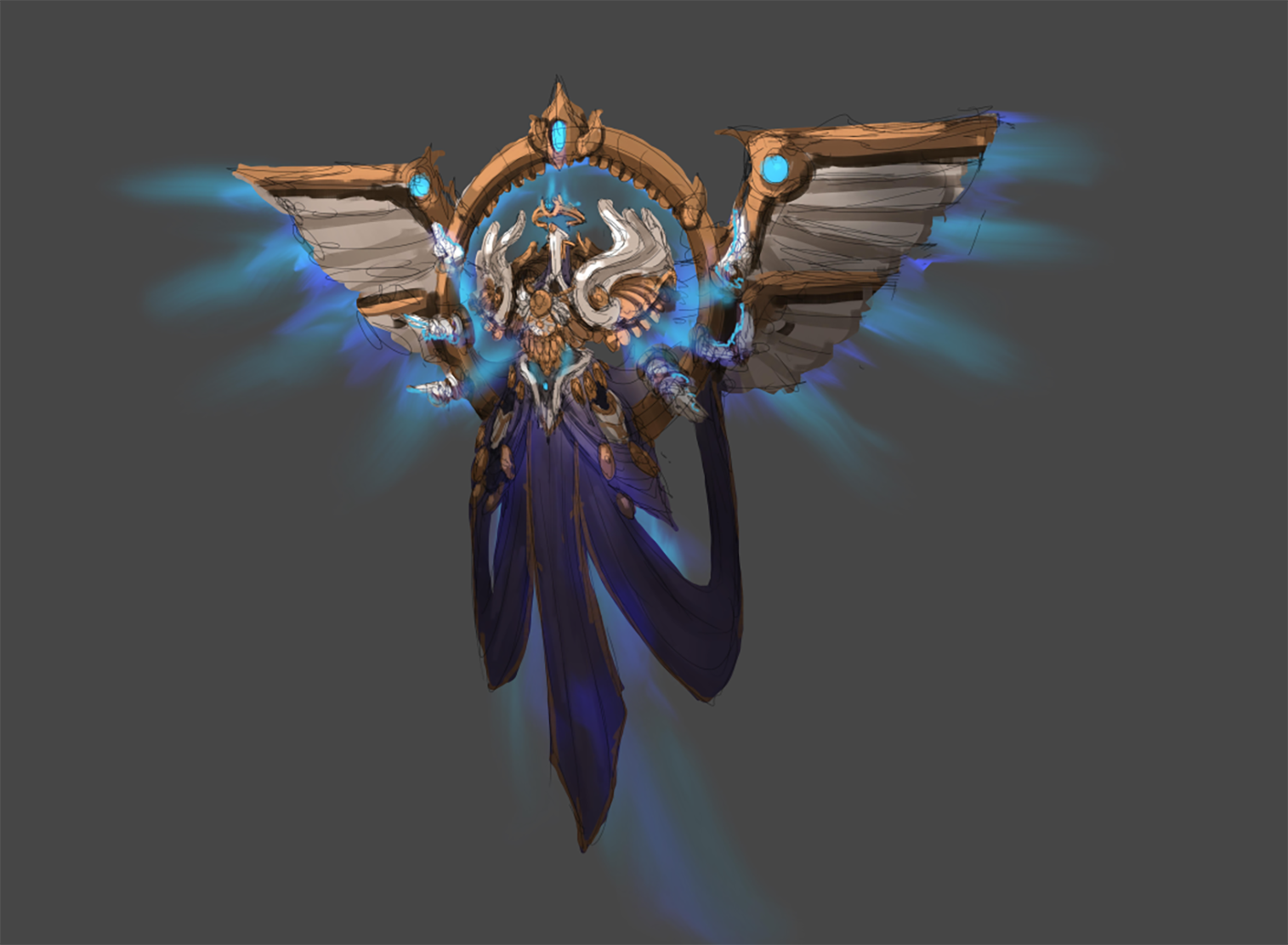
This take on the Q’rath capital unit was based on Bas Reliefs from the Persian Empire and the Zoastarian religion. Badass! However, the marquee element, the great geometric wing-mantle, did not show well from various perspectives, especially when the unit moved horizontally relative to the camera (see below). This problem came up again with the Absolver, ultimately forcing us to make it taller and the ring halos wider and thicker. This aspect became known as “clickability” or, the ability for a player to intuitively select their soldiers. Checking for clickability is now a critical phase in any concept for in-game assets.
Accounting for Roles & Gameplay:
The Saoshin is a great example of a unit that was “cursed.” We wanted to have a badass melee battle-caster with a big dramatic ability that let them “super-hero jump” to a friendly unit in peril to save them. Unfortunately, getting the ability to work right was constantly in tension with the unit’s identity and its role within the Q’rath army. After seven iterations, we gave it a ranged attack along with an AoE heal, allowing Saoshin to leap and fight with the Sipari they were tasked with protecting.
These issues would only be resolved when we dedicated resources to pre-art gameplay testing, which has been transformative to the efficiency of our pipeline. The lesson: measure three times, cut once.
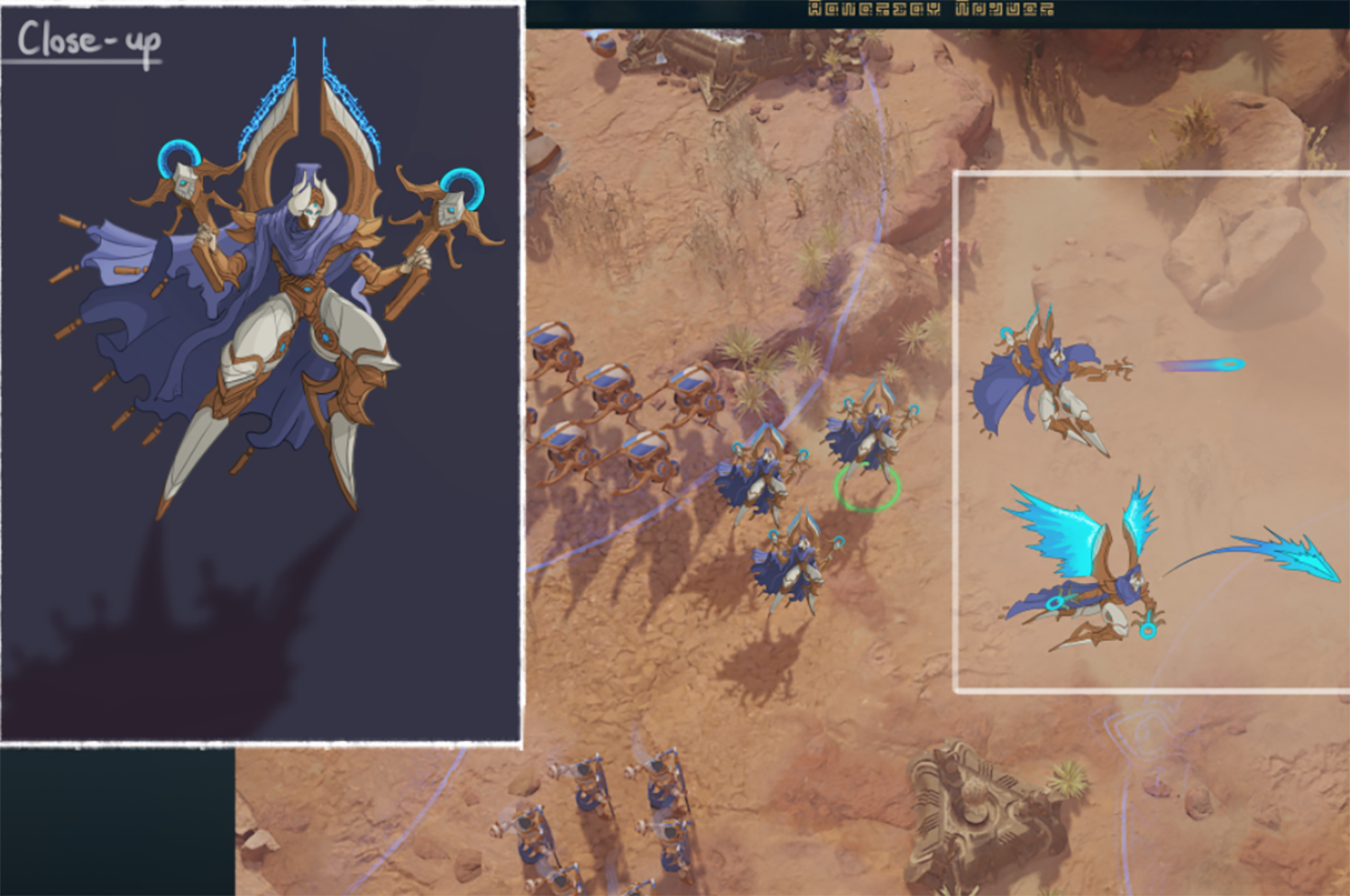
Pictured: A Future Q’rath unit being tested for readability and clickability.
Part II: Building on Aesthetics, Mechanical Nuance, and Soul
Going forward, our goals with Q’rath is three fold:
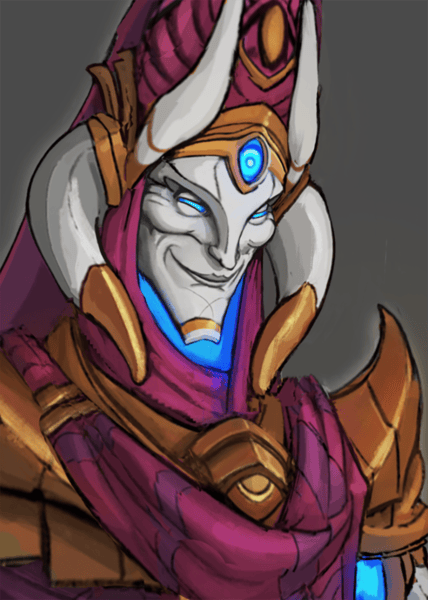
1. Use what we know to take exciting design risks. We want to increase the mechanical nuance of Q’rath and push the limits of what the faction can do. Currently, Q’rath is very direct and focused on how it executes its ahem, “strategies.” There is room to open the Angelic Empire up to more tricky tactics and our 6th Immortal aims to do just that. Normally, Q’rath tells you what it’s going to do and then does it. Immortal 6 is designed from the ground up to keep opponents guessing. 🙂
[Sneaky sneaky, hush, hush, hush.]
2. As we are able, we are going to lean away from the pristine “space paladin” aesthetic and more into the cosmic horror undercurrent of what the angels really are and what they really want to achieve. Currently, our game has a lot of hints about Rath’s intentions and alien nature but with the exception of a few characters, it’s subtle. Going forward, we will be bringing more of those themes to the surface.
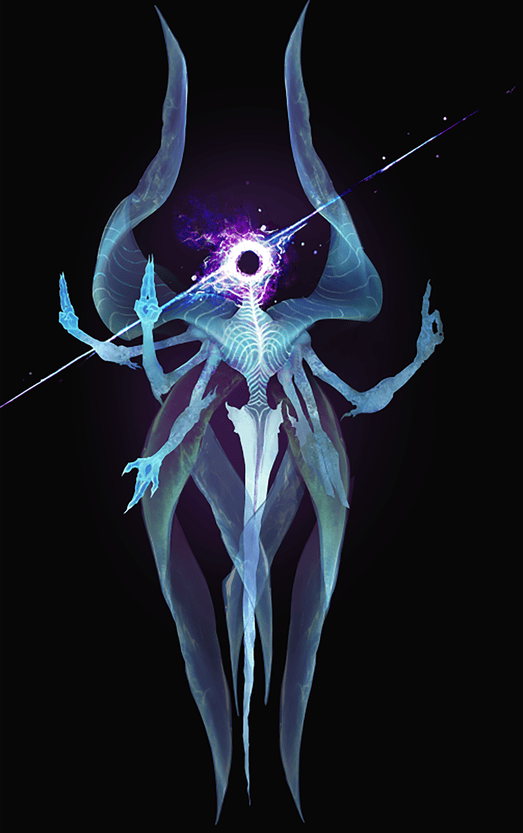

Pictured: Early explorations on the future of Q’rath.
3. Increase the spectacle of the faction and their abilities. We have learned a lot since our first days working in the Unreal Engine. The Absolver has a new planned VFX effect that brings a more cosmic element to their deployed attack, ripping the souls of the damned from their bodies and drawing them into a smoldering event horizon formed by the rotating halos.
Conclusion:
As always, thank you for sharing the road with us as we take further steps to make this game and its world a reality. It really is a privilege to wake up and work on IMMORTAL for you all. It is our hope that by giving you insights into our process, our triumphs and our missteps, that we can shed light on the realities of start-up life and indie game design. Until next time, May the Holy Aros, Emperor of Creation and Sire of the Angels of Rath hold you safe in Its burning hands.
Shar’Q’rath,
Dylan and the SunSpear Team.